
|
Photospace Gallery is proud to have shown exhibitions by Lucien Rizos since 2007. It's fair to say these exhibitions have taken varied forms ranging from conventional framed black & white photographs to installations of large colour prints, documents and ephemera (like this one), as well as video installation. 'Marble Art Ltd.' exhibition opens in room 1 of Photospace Gallery on Saturday 6th July, between 11.30am and 1.30pm. You're most welcome to come along. There is a limited number of 'Marble Arts Ltd' photo books available for sale at the gallery. Marble Art Ltd. was the business established 1957 in Wellington by John Fotiadis, the uncle of Lucien Rizos, who in 1951emigrated from Romania, through Greece, to New Zealand. The business was a manufacturer of souvenirs and objet d’art for the Kiwi home. In 1977 John Fotiadis returned to Romania and built a factory to supply these products to a European market. This exhibition concerns a Marble Art Ltd. catalogue printed in Trig-Jiu Romania, that documents wares from chess sets and lamps to coffee tables, and draw upon motifs from many civilisations. Amongst the items are a number of designs, originally produced in Wellington for the New Zealand tourist and domestic market, that reflect a newcomer’s efforts to respond to Maori cultural forms. On the gallery’s walls Rizos’ reconstruction of the Marble Art Ltd. catalogue details a 1970s Romanian view of New Zealand conceived wares designed to appeal to a European market. The small publication mimics the form of the original Romanian catalogue. This publication also includes an insightful contribution by Damian Skinner.  Photograph from 'Marble Art Ltd.' exhibition by Lucien Rizos, Photospace Gallery 6 July-3 August 2024  Poster for 'Marble Art Ltd.' exhibition by Lucien Rizos, Photospace Gallery 6 July-3 August 2024 Subject: PRECIS and restructuring of interview with Gerald LR Date: 13 November 2016 at 1:35 PM John Fotiadis was born in Kisinov, Basarabia. His mother's line came from a big population of Greek traders in Turkey... Smirna. In 1951 John Fotiadis came to New Zealand, with his wife, from Athens, where he worked for the International Refugee Organisation as an interpreter. He spoke Romanian, Greek, Russian and French, as well as English, which he learned in his home town of Bucharest, Romania. (.It is said that Romanians have a great affinity for languages because of the countries surrounding it, or ones that it had been involved with, such as Ukraine, Poland, Serbia, and Turkey.) In New Zealand, his first business was a house painting firm, Ideal Decorators; but he was always looking out for other business opportunities. made the leap from house painting to figurines when he went back to Romania for the first time since the end of WW2... that turned out to be the spark, when he saw what the Italians were doing. He bought moulds from Pisa, and from Volterra, where the alabaster works were. Buying sacks of alabaster, he returned to New Zealand with the rights to reproduce them. there were a lot of technical problems to overcome; but they were worked on by the co director Vasilios Bertos and john Fotiadis. They would experiment with techniques to imitate ivory, jade etc, after a day's work in the painting firm. MAORI FIGURINES... no market research was done, but JF thought why not supply Duty Free stores and tourist shops with this sort of thing. "...to be able to create these statues to appeal to the Maori..." The Figurines were conceived by a sculptor Jim Gawn. Q..do you think uncle John was conscious there may be a problem with the Maori? A... yes he was. But I took to the factory. Also --, Labour member for "At the time there was no objection from Maori to not receiving royalties or Koha for the use of Maori subject matter. Since then someone in Featherston has bought the business; but not sure how they stand with cultural rights. I think it is essential to find out what the position is today... Under Norman Kirk and Matiu Rata, we were anxious to see the evolution of this trend of Maori self determination." Greek and Romanian Immigrants working in the factory... in the 70's NZ's unemployment rate was much lower. And the rules were different. After working for 3 months people were able to leave and go back on the Unemployment benefit immediately. One of the problems JF had was training them each time. It they were not economic until fully trained, but it took months to master the craft. So when Greeks and Romanians passing through Wellington decided to work there, and wanted to settle down and stay on at the factory, the Immigration Dept objected, saying New Zealanders took priority at the expense of the foreign workers. Romanian factory in Trig-jiu... Early on there was an Indian entrepreneur in Wellington, who had connections with India. And his idea was to set up the factory in India instead of Romania. The advantages of India were lower taxation and cheaper labour costs. But JF chose Romania because he had a natural affinity of returning to his own country, but without leaving New Zealand. According to the contract with the Romanians, signed in October 1977, having built the factory he handed over industrial expertise, on the condition he received a proportion of the profits made by the Trig-Jiu factory from their export trade. As it turned out the Romanians produced only for the local market, and JF did not receive a cent for all his troubles... A lot of work was done for him in Australia, his products being introduced to a number of Australian companies such as Grace Brothers and David Jones. But he did not take this further,... M Art was large enough to take on the Australian market. Opening up NZ markets to cheap Asian Imports... Q... did the business eventually decline because of Govt policy, or did his figurines become unfashionable. A... " Govt policy here did not give a stuff for locally produced products". JF did not follow fashion trends, and did not select the right markets. He never reached the stage you could say the business was taking off. He needed to change his attitude towards sales. But he was reluctant to do that, because it meant raising the capital to expand. At one stage he was reluctant to take on more orders because he was unable to fulfil them. That was a problem a lot of NZ exporters faced. In time he did take out loans to sustain the expansion ideas he had ...... but needed more time to pay back taxes. He produced evidence that he was able to operate the business and employ people, along with raising the money. But the IRD wanted his back taxes paid back immediately..... This eventually resulted in Marble Art filing for bankruptcy....? Below - essay on Lucien Rizos' project by Damian Skinner. Please do not copy - reference only. 
0 Comments
Photospace Gallery is proud to have represented Andrew Ross' photography since early 1999. His work is in major public and private collections in NZ. This is a small selection of recent photographs from around Aotearoa - as usual all hand-printed and in handmade frames. The photographs are contact-printed by Andrew in the darkroom, directly from the 8" x 10" negatives to preserve maximum tonal quality and detail.  Andrew Ross - 'Beach house and Toyota Corolla, Kuaotunu, Coromandel Peninsula, 23/11/2023' - 8"x10" silver-gelatin contact print  Andrew Ross - 'Fisher Monoplane, Hurunui-o-rangi, Wairarapa, 7/5/2022' - 8"x10" silver-gelatin contact print 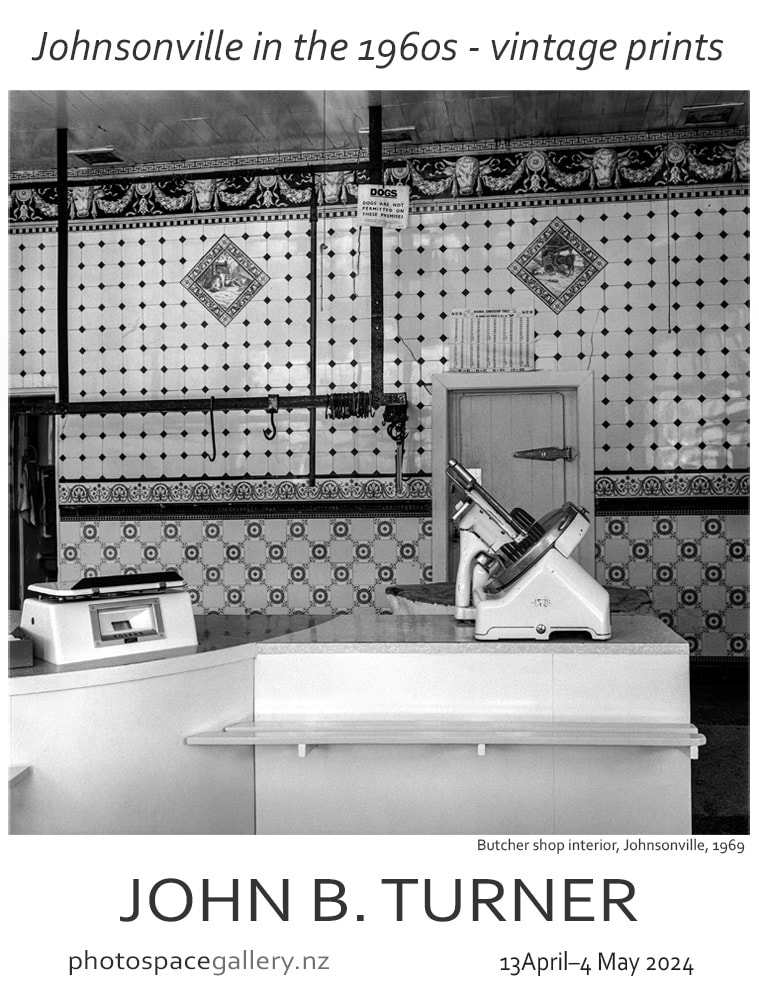 John B. Turner - 'Johnsonville in the 1960s - vintage prints' This exhibition has been extended: Monday 6th to Thursday 9th May, 10am to 2pm only. A selection of vintage silver-gelatin prints by John B. Turner is displayed in gallery room 1. The opening is on Saturday 13th April, 11.30am to 2pm, and the exhibition runs until 4th May, 2024. (John will not be attending the opening.) In 2019 I was involved in curating an exhibition of John's vintage photographs of Johnsonville for a display at Waitohi in Johnsonville on behalf of Photography Aotearoa. The intention was to show vintage prints from this set of photographs at Photospace during the run of 'A Walk Down Johnsonville Road'. But Covid-19 intervened, with NZ going into full lockdown and that plan had to be shelved. Until now. It's interesting, I think, to have John's vintage silver-gelatin photographs in the gallery on the wall opposite Mary Hutchinson's exhibition of recent digitally-captured and pigment-printed street photography - 'Digital' Both exhibitions run from 13th April (opening 11.30am-2pm) till 4th May, 2024. 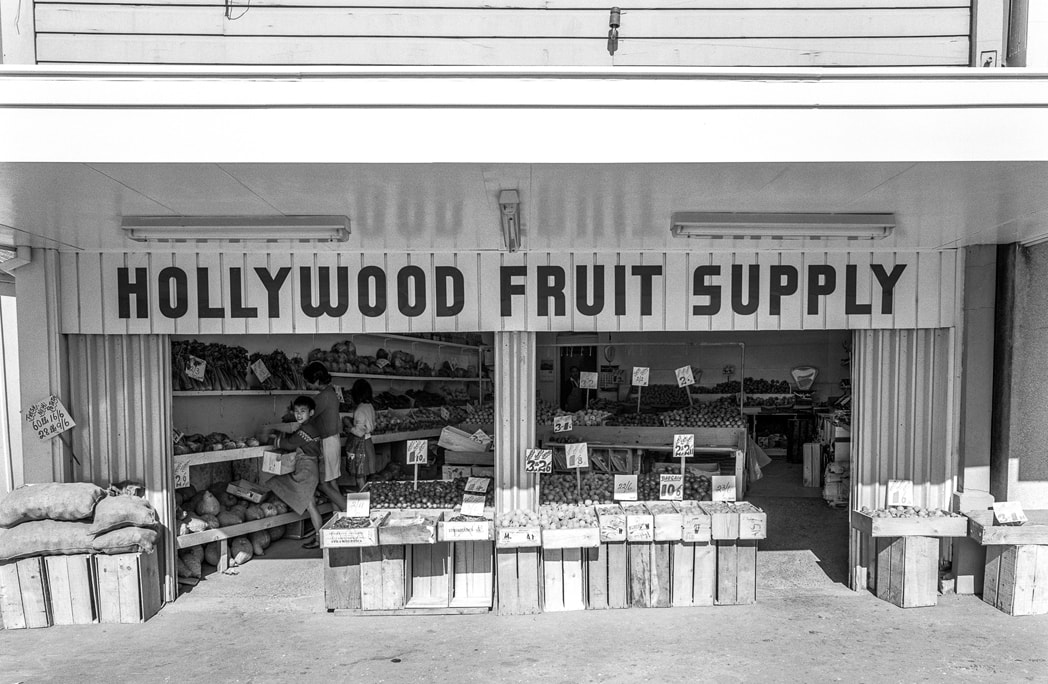 'Hollywood Fruit Supply, Johnsonville main road looking east, 1967' Photograph copyright John B. Turner John B Turner is an editor, publisher, writer and educator in the field of photography, as well as a photographer in his own right, although he has unselfishly put most of his energy into promoting other photographers work. He was highly influential in the development of contemporary New Zealand photography from the late 1960s through to the 1980s, and, despite relocating to Beijing a decade ago, he remains closely involved in the NZ scene. With his energy and passion, and the platforms of Elam (he was appointed as a lecturer at the University of Auckland’s Elam School of Fine Arts in 1971) and PhotoForum (an organisation he co-founded in 1973 that is still actively promoting NZ photography), he has exerted enormous influence on the early development of contemporary photography in this country. John currently lives in Beijing, China. 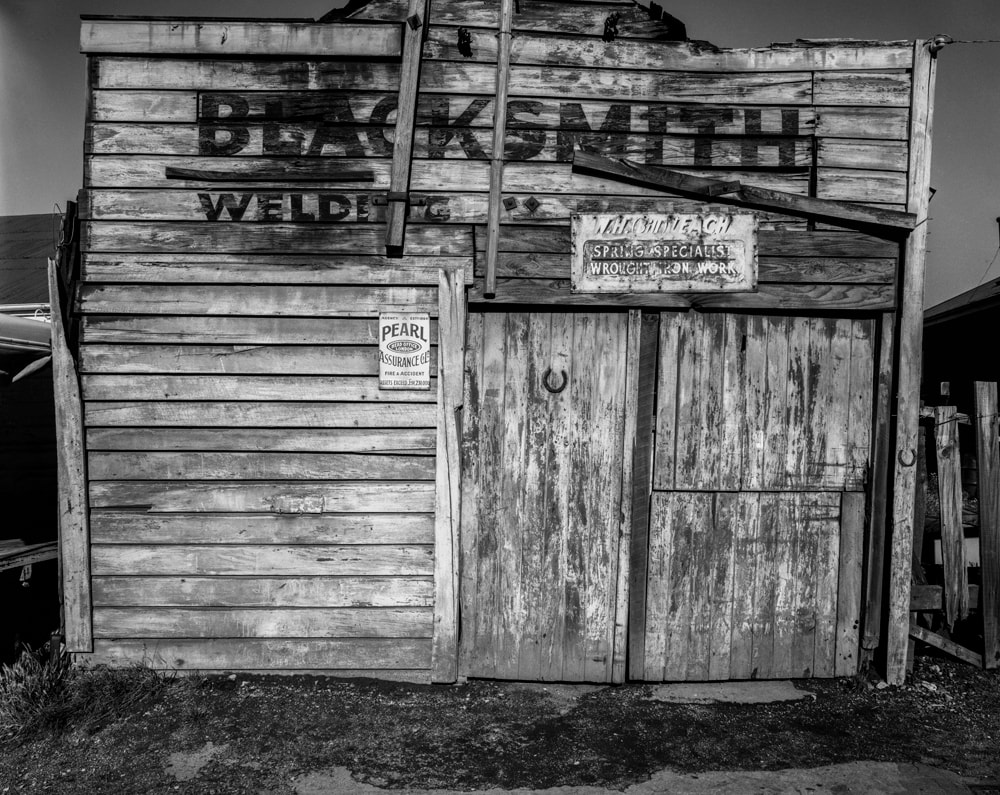 'Blacksmith, Main Road looking east, Johnsonville' (1966-69) Photograph copyright John B. Turner |
AuthorPhotography Matters II Categories |
||
 RSS Feed
